Okay, I took liberties with that quote,  which originally comes from the Gus van Sant movie To Die For and actually reads, “You aren’t really anybody in America if you’re not on TV.”  It comes to mind because two clients this week have shared stories about something they did last weekend (going kayaking and installing a window air conditioner) that included comments like, “And then we decided to post pictures on Facebook.”

When my family and I were in Hawaii in April, I noticed a creeping self-consciousness after awhile because, simultaneous to taking pictures of some place or event, I would think to myself, If this is a good picture, I’ll put it on our Hawaii blog and this is what I’ll say about it.  In other words, I became aware of my slide into leaving the present moment by planning my blog post.  My clients, too, were less present for air conditioner installing and kayaking because they allowed themselves to be preoccupied by planning the Facebook posts.  I imagine a process something like, While being photographed  balancing the air conditioner in the window, the person thinks of the caption that will accompany it: This is me balancing the air conditioner in the window.

I do not mean for this to turn into a rant about Facebook.  I believe every generation has its pitfalls, its siren call away from what we are doing right now.  But I also believe every generation requires its skeptics, those who say, “I’m not sure it’s a good thing to be so hooked into Facebook (or blog posts) that the planning of the next post occupies one part of our mind while the rest of our mind is shooting the rapids.”  That could prove dangerous.

And more than that, if we have had a devastating first relationship and now have a fledgling new relationship, and this new person notices that in the current heat wave, our apartment is brutally hot and goes out to buy a window unit and comes to install it for us because we don’t know how – it seems to me we’d want as much of our brain to be on-board as possible, to notice this moment, this moment where we find evidence that maybe, this time, we’ve found someone who cares about us.

Every Monday evening on the way home from work, I pass the community policing center (otherwise known as the police station) on NE 47th and Burnside.   There, as I wait for the light to change, I hear bagpipes.  It has been this way for years.  Some bagpiper has convinced the police station that s/he could use its rooftop parking lot after hours to march around and practice.  It makes sense that a bagpiper would find it difficult to locate a place to practice.  Anyway, no matter how I’m feeling, it does my heart good to hear music played loudly, well, and outdoors.

And of course, I love the bagpipes.  I still remember the first time I heard bagpipes playing Amazing Grace.  I lived, fittingly, in Scotland at the time.  I was eleven years old, and my mother was having a great time finding music and bringing it home.  She put this recording on, and not only did I get chills when all the bagpipes joined the first, but I started to weep.  I think my crying comes from the same place as my tears during the climax of Witness when the Amish villagers come over the rise to rescue Harrison Ford from the corrupt, murderous police; or in V is for Vendetta when the masses march on parliament all dressed like Guy Fawkes.  It has something to do with people joined in a common purpose, people saying somehow, “We, joined, are more powerful than the evil that has set itself against us.”

I will not pretend to be any sort of expert on the struggles going on around the world right now in Syria or Turkey or in other climes.  But I think art exists in part to point toward the heroic even when it emerges amidst chaos and violence.  There certainly is an amazing grace to doing what one feels is right even in the face of possible extermination.

Give it a listen.   https://www.youtube.com/watch?v=0syjecXN_no

A conversation occasionally emerges here in Portland about whether political correctness is a virtue or a vice. One camp maintains that it’s important to always use inclusive, non-demeaning language when speaking to and about others. The other camp believes this approach only enables sneaky and inauthentic people’s true colors to remain unexposed. Proponents of this latter approach have been known to say, “If someone holds an ignorant, insulting opinion about me, I’d rather know it than have them hide behind their PC language.”

This debate got me thinking about Sarah Kendall.

Sarah Kendall was the daughter of the wealthy Kendall family who lived in Sharon, Massachusetts. Sarah was a year younger than I, and rather than attending public school with the rest of us, she went to boarding school during the school year. I first met her at her family’s annual Christmas party when I was 10 years old. They traditionally invited neighbors each Christmastime for a festive gathering. That year, we lived on Moosehill at the top of a rising slope outside of Sharon proper. Moosehill was home to Sharon’s Audobon Sanctuary and whaling museum, and to numerous homestead-type houses owned by the Kendall family, as well as one mansion-like house they themselves occupied. The Christmas party was held in this latter house.

The entire crowd of party-goers – probably 50 or more of us – fitted easily in what I thought of as their living room. Now I’d call it a ballroom with couches and a fireplace. I’d been told the Kendalls had a girl my age named Sarah. I don’t know what I expected, but I was convinced someone who was rich would appear rich in some way. Yet Sarah was as normal-looking a nine-year-old as I’d ever met, with straight, shoulder-length brown hair, brown eyes and an open face. She and I both played the flute – a fact we discovered because party-goers had been asked to bring an instrument to play. I’d brought my flute without thinking through the consequences, and once I realized that at some point sheet music would be passed out and said instruments played, I anxiety-stricken for much of the party. Sarah Kendall and I shared the music for We Three Kings of Orient Are and I played quietly, hoping everyone would think the flute they heard was both of us.

Several grownups, Sarah’s mother included, suggested that, since we were so close in age, perhaps Sarah and I should get together some time. I was not against this idea. I may even have called her once so my mother could feel I’d been polite and followed through on the suggestion. I didn’t not want to get to know Sarah. But I was perplexed about how to go about it. She’d looked like a normal kid, but she wasn’t. She was rich, and I didn’t know how to behave toward a rich person. It seemed to me that trying to befriend a rich person opened up more opportunities for faux pas than my usual brand of friendship contained. A friendship error equivalent to using the wrong fork at a fancy table seemed probable when one was friends with a rich person. I wasn’t sure how to navigate this social minefield, and so I didn’t pursue it.

Fast forward three years. I was 13 now and had moved away from Sharon at the beginning of that school year but was back visiting my dear friend, Tina, for a few days. Tina and I were hanging out in her room. Tina’s mom, Donna, was a professional flautist and the flute teacher in Sharon if you wanted the best. She’d been my teacher when I’d lived in Sharon. Donna told us, “Sarah Kendall is coming for her lesson in a few minutes so I’d like you two to decide where you’re going to be and then stay there during her lesson so you don’t interrupt us.”

“We’re good here,” Tina said. She turned to me and said, “Sarah Kendall.” I told her about the Christmas party.

“Let’s see if we can see her come in,” Tina suggested. We went to their den where you could look out into the street. A large car pulled up. A chauffeur sat at the wheel, complete with chauffeur cap and uniform. We watched the car. We talked about the situation, sneaking small glances at each other then back to the chauffeur-driven car. “Man, what’s it like to have so much money you have a chauffeur?” “How can a parent be so busy they have to have a chauffeur drive their kid to their music lesson?” “Do you suppose she ever even sees her parents?” “Does he have to take her wherever she wants to go, or do her parents decide?”

We waited, and waited, and Sarah didn’t emerge from the car. Now that we were in the den, the upstairs seemed a boring place to be during the music lesson. In fact, not only was it boring, it did not have a refrigerator. Tina said, “Let’s go down to the kitchen before she comes in so we can make a snack.”

I followed Tina down the stairs. As we skirted the flute lesson area, I was seized with nastiness. I said in my most snide tone, “Well, Sarah Kendall’s so rich she has to have a chauffeur drive her to her flute lesson.”

Tina snickered and we continued on to the kitchen to make snacks, our ears cocked, waiting to hear the doorbell that would signal Sarah’s entrance. Tina found bagels in the freezer and remembered I preferred pumpernickel. She handed one to me. Still no doorbell. She handed me a fork to pry my bagel in half and found some orange juice in the refrigerator. Still no doorbell.

Then wafting down from the flute lesson area, we heard the strains of a fourth-year flute student warming up with her scales.

Tina gaped at me. “Oh my god, she was already here.” She made a strangled sound. “She had to have heard you.”

I covered my own mouth, mortified beyond words. This was unprecedented. Usually, I was careful not to be heard when making less-than-kind comments except by those I knew wouldn’t judge me unkindly for it. This comment had been meant for Tina’s ears only. I didn’t know what to do if my comments were overheard – especially by the person they were about.

We sat at the kitchen table, staring at each other and not daring to even speak while the lesson commenced. The front door was on the other side of the kitchen wall, and I hoped that Sarah would simply leave without seeing me.

Fat chance. Instead, at the lesson’s end, flute in its case and sheet music in her hands, Sarah came into the kitchen accompanied by Donna. Sarah wore glasses now, as did I, and her hair had grown past her shoulders. “Girls, this is Sarah Kendall. Sarah says you and she have met, Katrina.”

I looked up. Sarah shifted her sheet music into her left hand, which also held her flute case, and extended her right hand to me. “Hello. We met at my family’s Christmas party a few years ago,” Sarah said. “It’s nice to see you again, Katrina.”

I took her hand and shook it. “Hi. Nice to see you, too.”

Sarah nodded to Tina, then said to Donna, “Thanks again, Mrs. Hieken. See you next week.”

When she left, Donna stood next to the kitchen table. She looked toward, but not at us, and said, “Sarah is a quality person. Truly one of the nicest people I know, and a pleasure to have as a student.”

Perhaps this painful moment is one of the reasons I fall into the pro-political correctness camp. I can think of no way it did Sarah any good to hear how I “really” felt about her. It could only have served to make her feel more isolated from her peers. And of course, I didn’t really even know Sarah. I wasn’t saying anything true about her, or even true about my feelings about her. My comment was simply a 13-year-old’s uncomfortable, ignorant snarkiness, uttered to impress Tina. And probably most of us make similarly cutting remarks into adulthood. How could it have done Sarah any good to have yet another experience to prove to her what I’m sure she already knew: that people have preconceptions about what it means for someone to be from the upper classes and some of those preconceptions aren’t very nice?

If, on the other hand, I had kept my mouth shut on the walk down to the kitchen – if I’d been PC about it – when Sarah came to say “hello” after her lesson, I could have just said “hi.” She could have made whatever she wanted out of that “hi,” and maybe she would have made something of it that would have been a comfort, that would have been a balm to her aloneness. Instead, because I was not especially thinking about political correctness, my humiliated “hi” on the heels of passing judgment on her because she rode in a chauffeur-driven car to her lesson could not have been mistaken for kindness in any universe.

My mother tells a story about something she overheard at the Christmas party. A brazen adult came up to Sarah Kendall and asked her, “How does it feel to be rich?”

Apparently Sarah said quietly, “I don’t know. It’s my parents who are rich. I myself am quite poor.”

I would have liked to know the Sarah Kendall who enjoyed playing the flute and who at age 9 already had a sense that she herself had not earned these riches. That Sarah Kendall sounds like someone worth knowing, whether she was driven by a chauffeur to her flute lessons or not. I hope to never be judged by something so small and not of my doing, and if I occasionally judge others on details so insignificant, I’d like to keep that to myself until I come to my senses. Maybe that’s what political correctness is for: putting forth a proscribed nicety until you remember that we are all so much more than the trappings we present.

In an hour and a half, Portland’s Junior Rose Parade will begin a block from my office.  It is a big deal here, but I have to admit, I am a bit of a curmudgeon about it.  It is possible parades would never have been my thing, but going to one in Madras, Oregon at the age of four and being chased by a pirate with a scimitar didn’t help.  Really.  This guy in a pirate outfit seems to have gotten such glee at my fear of him that he left the parade and came after me.  It was hard to shake my terror, even after my grandma bought me orange sunglasses with Tony the Tiger in the upper corner and a pair of those clear plastic little kid high heels that stayed on your feet by strips of elastic across the toes and ankles.

So I have staunchly avoided parades in my lifetime, and for the most part, I am happy with that decision.  However, one parade managed to entice me.  25-ish years ago, I lived in Sisters, Oregon, as did my sister and her son, Chris, who was about two years old at the time of the parade in question.  I don’t remember what the excuse was for the parade, but somehow having a two-year-old in my life altered my parade position completely.  I couldn’t wait to get there with him.  I thought maybe the parade would change his life.  We joined the other folks who lined the streets, and pretty soon it was clear Chris would need to be higher if he was going to be able to see.  I hoisted him onto my shoulders, and there he stayed for the duration.

What a parade!  Eighty percent of it involved horses and the remaining twenty percent presented a variety of small motorized vehicles.  Some horses were ridden by Native Americans with bright Pendleton blankets peeking out in reds and turquoises from underneath the rider, some ridden by the Sisters’ version of the rhinestone cowboy.  The horses pranced and backed up.  Some reared on command.  But the really exciting thing to Chris was that THERE WERE HORSES WALKING RIGHT BY HIM, A STREAM OF EQUINE GORGEOUSNESS, DRESSED TO THE NINES.  And more amazing still, they pooped.  Without so much as an “Excuse me,” some long-legged, bespangled horse would just let one plop.  Right on the road.

I have revised my creed around parade-going: bring a kid with you.  It changes the entire experience.

It is 7:30 pm as I write this.  I am on the second floor in the front of our house, and outside the bedroom window, the setting sun makes the leaves of the hawthorn tree glow.  Actually, to be more precise, it’s the leaves of the wisteria that glow from the sun – the wisteria that we planted in our yard that has now climbed up into the hawthorn 30 feet above the sidewalk.  It would climb higher if it could have.  It’s a tenacious plant.  When it flowers, it creates a cascade of white that makes me think of tossed rice falling at a wedding.  Lovely as it is, it will kill the hawthorn over time if we don’t intervene.

There is a metaphor there waiting to be found, but all I can make of it is cliches.

It’s true, I’ve been thinking about Oedipus.  He comes to mind often as I sit with couples who see me for therapy, and I marvel at how much we humans do the very thing that is least likely to bring about the result we desire.  Short-tempered people know when they let something fly that their partner will be less likely to want to approach them – though this is the thing they desire most in the world.  Withdrawn people know their demeanor does not excite in their partner the respect they most long for.  As much as the talkative one knows her spouse wants nothing more than to feel there is room for him, still she talks on.  I know that when Garth muses aloud, “What shall I make for breakfast?” he isn’t actually asking me and it will be annoying if I rattle off a list of possibilities.  And still, sometimes, I rattle away.

Oedipus, as many of us know, learns he is going to do something heinous to the people he most loves: his parents.  So he leaves town to save them all from this fate.  Of course, because he doesn’t have some critical information – i.e., that the people he thought were his parents aren’t -, Oedipus manages to do the very things he’d hoped to avoid.

Sophocles believed it wasn’t just lack of information that brought Oedipus’ suffering, but also his very particular faults.  In couples therapy – maybe in any therapy – we hope for what Sophocles would not: that, armed with our own critical information (namely, awareness of our flaws and blind spots), we will be able to divert a tragic end.  We proceed in the hope that if Oedipus had known Jocasta was his mother and Laius his father, he would have made different choices.

As with all things human, bringing about our desired outcome is less straightforward than applying awareness of our flaws to our relationships.  Even with that critical information – when we know our partner wants space to step into, or to be vibrantly engaged, or to be spoken to with a calm voice, or to be left alone to figure breakfast out himself – sometimes we don’t act on the knowledge we have.  Whether because we forget, or, for just a moment, don’t care, or because it slips out even before we can try to remember, we still act like Oedipus sometimes.

Perhaps it’s pure rationalization that makes me feel it’s still worthwhile to learn what we can about each other.  After all, I’d be out of a job if I believed that falling short of absolute success meant we shouldn’t bother trying at all.  But just as I think it’s still worth addressing climate change, for example, though we have already exceeded the no-return 350 parts per million, I believe there is worth in educating ourselves about ourselves, and about the people we choose to partner with.  Likely Garth can’t hope for a future where I will never again take his thinking out loud as permission to offer various breakfast menus.  But wouldn’t things be better if sometimes I were able to refrain?  And to do that sometimes, all it takes is some knowledge and a little humbleness.

Sophocles was right, as it happens.  Oedipus didn’t just need to know the facts – though those certainly would have helped.  It was also required that he accept his own need for humility.

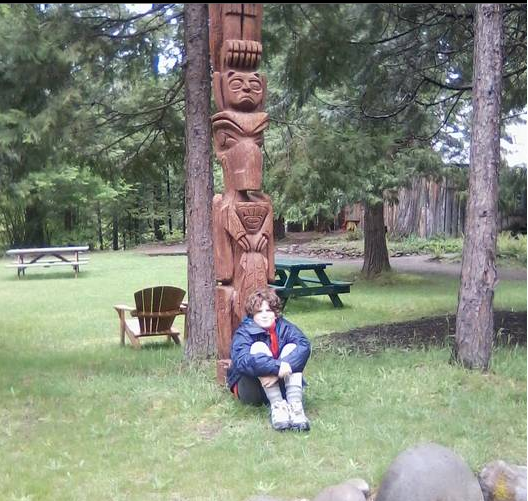
Breitenbush Hotsprings is a retreat center two-plus hours outside of Portland where Garth and I and our kids have gone since Kami was barely walking.  We have likely gone more than 30 times in the past 13 years, usually as a family, occasionally in ones, twos or threes.  This past Wednesday, I spontaneously decided to take Luken for an overnight.  There were 60 or 70 people there at the same time we were.  Walking into the grounds, Luken remembered one of our rituals and asked to be photographed in front of the totem pole.

lukenTotem

When we arrived around 4:00 in the afternoon, it was cold enough that I left a quart of milk outside our cabin on the stoop rather than bringing it to the lodge refrigerator.  Within the hour, someone had taken it.  This is so unusual in this place that it takes my breath away.

After dinner the first day, Luken and I visit the Sulfur God.  Many years ago, this was the name we gave to an almost hundred-year-old kiosk-like thing that was built atop sulfur-smelling hot water that issued forth from the ground.  We must have thought it looked something like a structure that would have been built to house an oracle.  As Luken and I leap the stream we have to cross to get there, Luken remembers the time we found a bright orange crawdad in the water.  This time, we find an earthworm.  It is bloated and gray.  I don’t exactly understand how slow-crawling creatures come to fall into these low pools of terribly hot water, but it cooks them right away when they do.

Two girls – Esther and Clara – stretch in the least hot hot-tub like sleek seals.  They cannot be more the 7 years old.  Clara’s two front teeth are gone.  Their parents are large, lumbering people, and affable.  It is hard to see how these two lithe creatures came from these parents, but I imagine that is always the way.  People who have not met my children ask me if they look like me and I’m not sure how to answer.  That is, no, and, a little.  Esther and Clara are everything wonderful about young girls: curious, wide-eyed, easily amused, and occasionally bashful.  I tell them that when I go in the cold tub, I try and stay in for one minute.  They count one-Mississippi, two-Mississippi, up to 60- Mississippi the next time I go in.  They want to know will we be at the Meadow Pools tomorrow because that’s where they are going.  At breakfast the next morning, from a few tables over, I hear Esther tell Clara that everything she’s had so far for breakfast is “just delicious.”

After breakfast, Luken and I go on the Bridge Walk.  It is the beginning of one of the Gorge trails and we call it thus because of the many small bridges involved in following the trail.  Luken talks about airplanes and about the memoir we are reading about Roald Dahl’s time in the RAF during WWII.  It is gripping, and we return again and again to certain parts:  “Can you believe his commanding officer sent him to the wrong coordinates?  Can you believe he was asked to engage German bombers in an airplane he’d only flown for a total of seven hours?”  In between airplane talk, I say, “That’s a ladyslipper; your Bumpa used to always point those out.  This is a mountain strawberry.  These will have huckleberries on them in a couple months.”  Luken says, “Oh, oxalis!”  We each pick a couple and chew on them, our salivary glands cramping from the tartness.

At lunch, at a table adjacent to us, a woman says, “It’s amazing the variety you can get just cooking in a vegetarian manner.  I was kind of worried about that, to tell you the truth.”  She and her table-mates are here for a workshop of some sort – one on dreams, or one on Living the Embodied Life, which are the two being offered – and I think to myself, This is how it happens: people come up here for a workshop they want, and their comfort is stretched just a little, and they learn the world isn’t quite the way they thought previously.  It is larger with more possibilities.

Wherever we walk, there are enormous trees.  Mountain rhododendron sprawl here and there, some of them sporting two-toned open blossoms of hot pink and magenta and others tight, flame-shaped buds.

It is always hard to leave, and most especially when one has been for less than 24 hours.  Unless you are a 12-year-old boy who misses his dad after a day.  The gravel road is rutted on the way out.  For a number of years, someone made a shrine by the side of the road of all the hub caps that were liberated by those ruts.  It’s not here now, and I miss it.

Boxes that were not mine:  My second year of graduate school, I lived with a woman up in the hills of Sierra Madre, CA.  Her name was Toby.  She was a social worker and therapist, and a reluctant smoker.  By which I mean, she really wanted to quit but had tried so many times that, well into her 50’s, she had given up.  She had the vertical lines around her mouth common to longtime smokers, born of their lips crowding around a cigarette countless times.  She did not dye her hair.  She owned a Volvo, and the most affectionate golden retriever I have ever met.  His name was Shamus, and to this day I do not ask when he died because I prefer to think he has not.  She was very kind, and quite busy, and my favorite memory of her is when we sat together one night watching Jane Campion’s Angel at My Table and her loving it and saying for weeks afterwards, “Only a woman could have made that movie.”

When I returned to Oregon, Toby was convinced I’d left several boxes behind in her basement.  It was possible.  I had been a bit hell-bent getting out of there, sick of LA and eager to get a job in Portland with my freshly minted MSW (acquired 20 years ago this month, by the way).  Years passed, and Toby asked me to please do something about the boxes.  Luckily, a toddler I’d known when I lived in the area was now a teenager and, for money, she agreed to ship the boxes to me.  They arrived: six boxes with a few words scrawled on each one the way you do when you put things in storage to remind you what’s in there.  It was not my handwriting.

How I would like to tell you that when I opened the boxes, I discovered interesting and unusual artifacts from someone else’s life – or even from my own life that I’d forgotten about.  Instead, I had numerous back issues of Car and Driver magazine.  Thank goodness for the  Free Bench.

Yesterday, biking home, I saw another biker who instead of wearing this

wore this

It was a little dissonant, merging two worlds in an unexpected way.  It made me think, of course, about the few years I took English horseback riding lessons, starting at age 11 when we lived in Scotland.  I didn’t want to learn to ride a horse because of the velvety helmet, but it didn’t hurt!  Mine had a golden yellow satin-y lining. I remember the helmet measured 6 and 7/8 inches.  Meaning my brains were not overly large.

I loved my helmet, I loved my jodphurs, I loved my riding crop.  I loved riding a horse whose ears pricked forward.  I remember Amber who was enormous and named for his color, and who earned me a grooming commendation at horse camp because his coat glowed so and his mane was made for plaiting.  I remember Pokey, who was named ironically.  I remember Blueprint, who threw me, and Colonel Flaxie, who was the first horse I ever road, and Shawnee, who had such a gentle lope a person could have taken a nap on her back.

The woman on the bike had the right style going, but I doubt she’ll be making the sort of memories with her bike that I made with horses – even if she does have the right headgear for it.

The title of this blog entry was going to be “Daring to Be Ordinary.”  In it, I planned to explain how last year at this time, I had all sorts of hopes and dreams about my writing, and how this year, I have scaled those back to a more manageable and modest scope.  I even planned to offer supporting documentation for this new stance.  I’d quote Adam Phillips, a British psychoanalyst who recently wrote an essay that invites us to give up the idea that we could have been a contender.  Who says? Russell asks.  Look at all the ways that bemoaning our ordinary life gets in the way of enjoying that ordinary life.

There is a certain appeal to crying, “Uncle!” in the face of one’s unsatisfied wantings.  Last year, I wrote a story that was exhilarating to produce and decided it was time to get back into the fray – I’d figure out possible markets for the story, send it out, keep track of rejections, keep sending it out, etc., etc. – only I’d forgotten what it feels like to have something rejected.  In case there is any doubt about this, it doesn’t feel good.  Maybe I didn’t want to participate in this process after all.

It followed, then, that if I just copped to being ordinary, I’d be able to step out of the entire agonizing sequence of wanting, striving, failing; wanting, striving, failing; wanting, striving, failing.  It appeared that the best place to stop that sequence was at the point of wanting.  If I resolved not to want, or if I shaped my wanting into something more attainable (as in, I don’t actually want that cute boy to date me, I just want him to smile back when I smile at him), then maybe I won’t feel this crappy feeling of wanting something I don’t get.

That was my idea a few days ago.  I’d get ahold of my wanting, I’d stop the cycle, I’d be heroic in your eyes – in an ordinary hero sort of way.  But damned if last weekend’s writing retreat didn’t get me back in touch with some wants I have for my writing.  So I had to change my title because while there might be daring in accepting one’s ordinariness, there is maybe even greater daring in being in each and every moment: being who we are when we want, and who we are when we are rejected, and who we are when we realize we’re no Virginia Woolf, and who we are when, even so, there are some things we want as a writer.