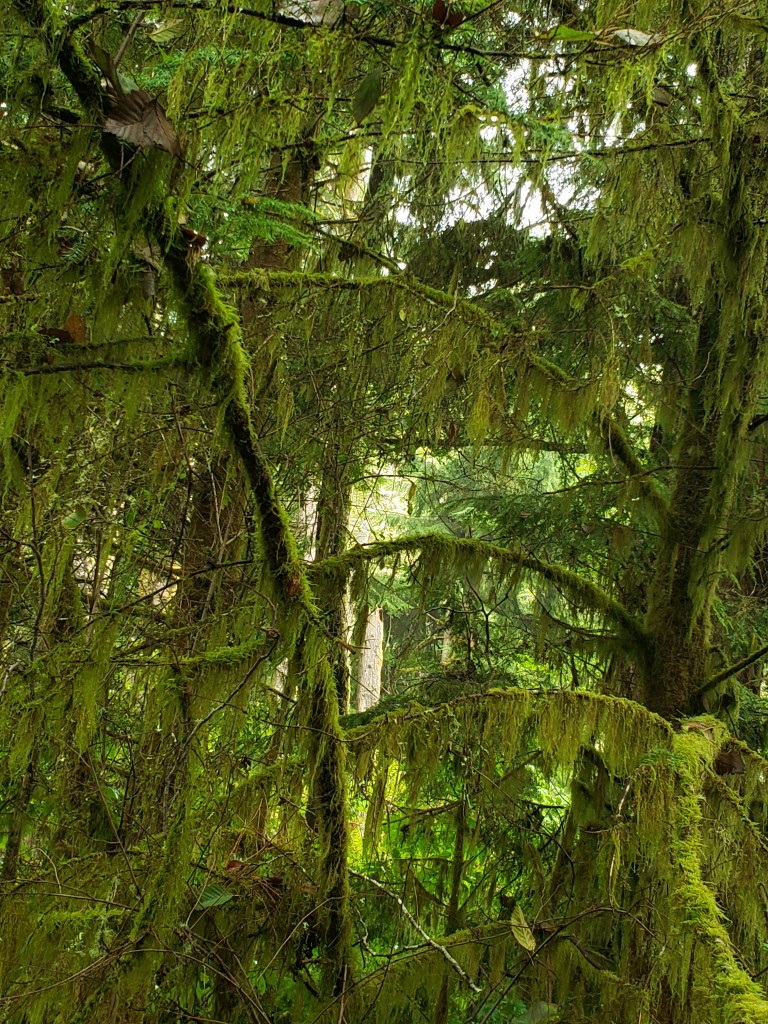
On Facebook the other day, someone posted a quote from the inimitable Robin Wall Kimmerer. In essence, she said that even when the world is wounded, she can’t help but love it. I’m afraid I took this up as a command: thou shalt love the world even when it’s wounded. As if, amidst these horrible fires — Oregon’s, but also across our country, and our continent, and other continents — it was my job to dig deep and love the world even while it burned.
At any other time, I might not have experienced the quote this way, but I was deep in feeling reverberations from six years ago. COVID had hit, and then fires tore through forest land that was precious to me, bringing air quality twice what we’re experiencing now. Back then, I felt trapped and frozen. I’d already agonized over how I could possibly protect my kids from this killing virus. How could I keep them safe from this burning earth as well? My repertoire generally consisted of throwing my body between them and any threat, but viruses and smoke have a way of infiltrating physical boundaries. There was nothing to do with my coiled, protective energy except stay inside.
Not surprisingly, that six-years-ago time came back to me with our current burning forests and poor air quality. Once again, we’re all on house arrest until this smoke passes. Feeling trapped and frozen again means I’m easily overwhelmed. What, another thing you want me to do!?! I’m over here just trying to play out the clock until things change, and RWK wants me to add loving the earth to my plate?
This time around, though, I’ve been trying to not trap myself. I ventured out Tuesday evening to sing with the old-time music choir I’m in (singing with a group never fails to deliver), and yesterday I kept my afternoon appointment with a body worker I’ve had a few sessions with. Her office is in one of Portland’s industrial districts. Heading toward downtown, my car moved through visible pockets of smoke, as if driving through low clouds. Smoke casts an eerie light; my heart sank while simultaneously feeling connected to everyone else on the road.
My appointment was held in an office on the second floor of a warehouse building, roughly fifty feet from the parking lot to her door — up clanging metal stairs that hug the outside of the building. When my appointment concluded, I walked outside and paused on the high landing. I couldn’t help but notice that, dotted among the other cement-sided warehouses and black-topped parking lots and criss-crossing roads, mature trees blossomed into full leaf. Seen through the smoky air, they looked somewhat beleaguered — and still, they were there. It was the easiest thing possible to appreciate their beauty and their presence. There weren’t enough of them to counteract the smoky air, and yet, there they were, still breathing in carbon dioxide and breathing out oxygen. How could a person not love that?
I was reminded, too, of how good it feels to love. My heart had a little Grinch moment, growing a few sizes larger as I made room to love those trees.
This morning — my birthday morning, by the way — it occurs to me that it’s even more simple than everything I just described. I don’t need to deliberately try to love the world even when it’s wounded. I do love the world. Maybe RWK should have said, “Remember the love you have for the world.” All I needed was that reminder: that love is already — always — there.