It’s true, I’ve been thinking about Oedipus.  He comes to mind often as I sit with couples who see me for therapy, and I marvel at how much we humans do the very thing that is least likely to bring about the result we desire.  Short-tempered people know when they let something fly that their partner will be less likely to want to approach them – though this is the thing they desire most in the world.  Withdrawn people know their demeanor does not excite in their partner the respect they most long for.  As much as the talkative one knows her spouse wants nothing more than to feel there is room for him, still she talks on.  I know that when Garth muses aloud, “What shall I make for breakfast?” he isn’t actually asking me and it will be annoying if I rattle off a list of possibilities.  And still, sometimes, I rattle away.

Oedipus, as many of us know, learns he is going to do something heinous to the people he most loves: his parents.  So he leaves town to save them all from this fate.  Of course, because he doesn’t have some critical information – i.e., that the people he thought were his parents aren’t -, Oedipus manages to do the very things he’d hoped to avoid.

Sophocles believed it wasn’t just lack of information that brought Oedipus’ suffering, but also his very particular faults.  In couples therapy – maybe in any therapy – we hope for what Sophocles would not: that, armed with our own critical information (namely, awareness of our flaws and blind spots), we will be able to divert a tragic end.  We proceed in the hope that if Oedipus had known Jocasta was his mother and Laius his father, he would have made different choices.

As with all things human, bringing about our desired outcome is less straightforward than applying awareness of our flaws to our relationships.  Even with that critical information – when we know our partner wants space to step into, or to be vibrantly engaged, or to be spoken to with a calm voice, or to be left alone to figure breakfast out himself – sometimes we don’t act on the knowledge we have.  Whether because we forget, or, for just a moment, don’t care, or because it slips out even before we can try to remember, we still act like Oedipus sometimes.

Perhaps it’s pure rationalization that makes me feel it’s still worthwhile to learn what we can about each other.  After all, I’d be out of a job if I believed that falling short of absolute success meant we shouldn’t bother trying at all.  But just as I think it’s still worth addressing climate change, for example, though we have already exceeded the no-return 350 parts per million, I believe there is worth in educating ourselves about ourselves, and about the people we choose to partner with.  Likely Garth can’t hope for a future where I will never again take his thinking out loud as permission to offer various breakfast menus.  But wouldn’t things be better if sometimes I were able to refrain?  And to do that sometimes, all it takes is some knowledge and a little humbleness.

Sophocles was right, as it happens.  Oedipus didn’t just need to know the facts – though those certainly would have helped.  It was also required that he accept his own need for humility.

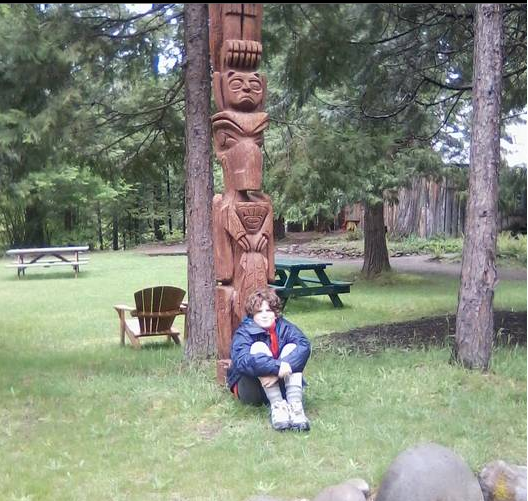
Breitenbush Hotsprings is a retreat center two-plus hours outside of Portland where Garth and I and our kids have gone since Kami was barely walking.  We have likely gone more than 30 times in the past 13 years, usually as a family, occasionally in ones, twos or threes.  This past Wednesday, I spontaneously decided to take Luken for an overnight.  There were 60 or 70 people there at the same time we were.  Walking into the grounds, Luken remembered one of our rituals and asked to be photographed in front of the totem pole.

lukenTotem

When we arrived around 4:00 in the afternoon, it was cold enough that I left a quart of milk outside our cabin on the stoop rather than bringing it to the lodge refrigerator.  Within the hour, someone had taken it.  This is so unusual in this place that it takes my breath away.

After dinner the first day, Luken and I visit the Sulfur God.  Many years ago, this was the name we gave to an almost hundred-year-old kiosk-like thing that was built atop sulfur-smelling hot water that issued forth from the ground.  We must have thought it looked something like a structure that would have been built to house an oracle.  As Luken and I leap the stream we have to cross to get there, Luken remembers the time we found a bright orange crawdad in the water.  This time, we find an earthworm.  It is bloated and gray.  I don’t exactly understand how slow-crawling creatures come to fall into these low pools of terribly hot water, but it cooks them right away when they do.

Two girls – Esther and Clara – stretch in the least hot hot-tub like sleek seals.  They cannot be more the 7 years old.  Clara’s two front teeth are gone.  Their parents are large, lumbering people, and affable.  It is hard to see how these two lithe creatures came from these parents, but I imagine that is always the way.  People who have not met my children ask me if they look like me and I’m not sure how to answer.  That is, no, and, a little.  Esther and Clara are everything wonderful about young girls: curious, wide-eyed, easily amused, and occasionally bashful.  I tell them that when I go in the cold tub, I try and stay in for one minute.  They count one-Mississippi, two-Mississippi, up to 60- Mississippi the next time I go in.  They want to know will we be at the Meadow Pools tomorrow because that’s where they are going.  At breakfast the next morning, from a few tables over, I hear Esther tell Clara that everything she’s had so far for breakfast is “just delicious.”

After breakfast, Luken and I go on the Bridge Walk.  It is the beginning of one of the Gorge trails and we call it thus because of the many small bridges involved in following the trail.  Luken talks about airplanes and about the memoir we are reading about Roald Dahl’s time in the RAF during WWII.  It is gripping, and we return again and again to certain parts:  “Can you believe his commanding officer sent him to the wrong coordinates?  Can you believe he was asked to engage German bombers in an airplane he’d only flown for a total of seven hours?”  In between airplane talk, I say, “That’s a ladyslipper; your Bumpa used to always point those out.  This is a mountain strawberry.  These will have huckleberries on them in a couple months.”  Luken says, “Oh, oxalis!”  We each pick a couple and chew on them, our salivary glands cramping from the tartness.

At lunch, at a table adjacent to us, a woman says, “It’s amazing the variety you can get just cooking in a vegetarian manner.  I was kind of worried about that, to tell you the truth.”  She and her table-mates are here for a workshop of some sort – one on dreams, or one on Living the Embodied Life, which are the two being offered – and I think to myself, This is how it happens: people come up here for a workshop they want, and their comfort is stretched just a little, and they learn the world isn’t quite the way they thought previously.  It is larger with more possibilities.

Wherever we walk, there are enormous trees.  Mountain rhododendron sprawl here and there, some of them sporting two-toned open blossoms of hot pink and magenta and others tight, flame-shaped buds.

It is always hard to leave, and most especially when one has been for less than 24 hours.  Unless you are a 12-year-old boy who misses his dad after a day.  The gravel road is rutted on the way out.  For a number of years, someone made a shrine by the side of the road of all the hub caps that were liberated by those ruts.  It’s not here now, and I miss it.

Boxes that were not mine:  My second year of graduate school, I lived with a woman up in the hills of Sierra Madre, CA.  Her name was Toby.  She was a social worker and therapist, and a reluctant smoker.  By which I mean, she really wanted to quit but had tried so many times that, well into her 50’s, she had given up.  She had the vertical lines around her mouth common to longtime smokers, born of their lips crowding around a cigarette countless times.  She did not dye her hair.  She owned a Volvo, and the most affectionate golden retriever I have ever met.  His name was Shamus, and to this day I do not ask when he died because I prefer to think he has not.  She was very kind, and quite busy, and my favorite memory of her is when we sat together one night watching Jane Campion’s Angel at My Table and her loving it and saying for weeks afterwards, “Only a woman could have made that movie.”

When I returned to Oregon, Toby was convinced I’d left several boxes behind in her basement.  It was possible.  I had been a bit hell-bent getting out of there, sick of LA and eager to get a job in Portland with my freshly minted MSW (acquired 20 years ago this month, by the way).  Years passed, and Toby asked me to please do something about the boxes.  Luckily, a toddler I’d known when I lived in the area was now a teenager and, for money, she agreed to ship the boxes to me.  They arrived: six boxes with a few words scrawled on each one the way you do when you put things in storage to remind you what’s in there.  It was not my handwriting.

How I would like to tell you that when I opened the boxes, I discovered interesting and unusual artifacts from someone else’s life – or even from my own life that I’d forgotten about.  Instead, I had numerous back issues of Car and Driver magazine.  Thank goodness for the  Free Bench.

Yesterday, biking home, I saw another biker who instead of wearing this

wore this

It was a little dissonant, merging two worlds in an unexpected way.  It made me think, of course, about the few years I took English horseback riding lessons, starting at age 11 when we lived in Scotland.  I didn’t want to learn to ride a horse because of the velvety helmet, but it didn’t hurt!  Mine had a golden yellow satin-y lining. I remember the helmet measured 6 and 7/8 inches.  Meaning my brains were not overly large.

I loved my helmet, I loved my jodphurs, I loved my riding crop.  I loved riding a horse whose ears pricked forward.  I remember Amber who was enormous and named for his color, and who earned me a grooming commendation at horse camp because his coat glowed so and his mane was made for plaiting.  I remember Pokey, who was named ironically.  I remember Blueprint, who threw me, and Colonel Flaxie, who was the first horse I ever road, and Shawnee, who had such a gentle lope a person could have taken a nap on her back.

The woman on the bike had the right style going, but I doubt she’ll be making the sort of memories with her bike that I made with horses – even if she does have the right headgear for it.

The title of this blog entry was going to be “Daring to Be Ordinary.”  In it, I planned to explain how last year at this time, I had all sorts of hopes and dreams about my writing, and how this year, I have scaled those back to a more manageable and modest scope.  I even planned to offer supporting documentation for this new stance.  I’d quote Adam Phillips, a British psychoanalyst who recently wrote an essay that invites us to give up the idea that we could have been a contender.  Who says? Russell asks.  Look at all the ways that bemoaning our ordinary life gets in the way of enjoying that ordinary life.

There is a certain appeal to crying, “Uncle!” in the face of one’s unsatisfied wantings.  Last year, I wrote a story that was exhilarating to produce and decided it was time to get back into the fray – I’d figure out possible markets for the story, send it out, keep track of rejections, keep sending it out, etc., etc. – only I’d forgotten what it feels like to have something rejected.  In case there is any doubt about this, it doesn’t feel good.  Maybe I didn’t want to participate in this process after all.

It followed, then, that if I just copped to being ordinary, I’d be able to step out of the entire agonizing sequence of wanting, striving, failing; wanting, striving, failing; wanting, striving, failing.  It appeared that the best place to stop that sequence was at the point of wanting.  If I resolved not to want, or if I shaped my wanting into something more attainable (as in, I don’t actually want that cute boy to date me, I just want him to smile back when I smile at him), then maybe I won’t feel this crappy feeling of wanting something I don’t get.

That was my idea a few days ago.  I’d get ahold of my wanting, I’d stop the cycle, I’d be heroic in your eyes – in an ordinary hero sort of way.  But damned if last weekend’s writing retreat didn’t get me back in touch with some wants I have for my writing.  So I had to change my title because while there might be daring in accepting one’s ordinariness, there is maybe even greater daring in being in each and every moment: being who we are when we want, and who we are when we are rejected, and who we are when we realize we’re no Virginia Woolf, and who we are when, even so, there are some things we want as a writer.

1)   If the guide book says there are lots of roosters on Kaua’i, really take this information in.  Read it again: “THERE ARE A LOT OF ROOSTERS ON KAUA’I.”  Think about what you know about roosters: among other things, they like to crow.  If there are a lot of roosters, then it stands to reason that a lot of roosters will be crowing.  Ask yourself, What might I need that I otherwise might not bring on an island where there are a lot of crowing roosters?  Ear plugs? A white-noise machine?  A shotgun?

2)  If you allow yourself for the first time in your life to order yourself a pair of prescription sunglasses, do not convince yourself that the ocean is gentle enough and you are savvy enough that you can wear the sunglasses while boogie boarding.  And if you wear them boogie boarding anyway, when your husband says, “You might want to take those off and put them in the beach bag,” listen to him.

3)  If a red-haired, 20-something hitch hiker dressed in shorts and a straw hat stands by the side of the road next to a pile of coconuts, give him a ride.  It will be fun.

4)  If someone you meet on the island says about Lydgate Park, “The snorkeling isn’t that great,” don’t believe her.  Any moment when you are under water and there are colorful fish swimming with you is an amazing moment.

5)  If you go to Jo-Jo’s Shave Ice Shack because the guidebook says it’s the best shave ice on the island, try not to get so bored waiting in the long line that you slump against the counter and accidentally knock over the tip jar – which happens to be an old glass blender.  Because if you do, glass will go everywhere and the sullen 20-something who is the sole worker there will use this as an opportunity to shoo all the customers out and close the shack for ten minutes while he makes sure he has swept up all the glass.  And ten minutes is just long enough for the one who made this mistake to feel so embarrassed that they don’t want to go in after 10 minutes because everyone will know the delay was their fault.  But, hey, even if you forget these details, don’t sweat it.  The island is crawling with shave ice places, and lots of them are pretty good – even if they aren’t Jo-Jo’s.  You’ll still be able to  find flavors like Hurricane, Buttered Popcorn and Dill Pickle, and you may even decide to eat all three flavors at the same time.


I recently bought some coffee that, by mistake, was un-ground, and so now I find myself every morning grinding the beans for my coffee – and for as long as I live, this will remind me of my friend, Steve Novick’s mom, Becky.

My freshman year of college at the University of Oregon, Steve and I became friends.  A mutual friend actually owned a car, and occasionally Steve would remain after the end of the school day in order to socialize with us – which meant we had to find a way to get him back home to Cottage Grove.

Steve lived in Cottage Grove with his mom, dad, and two younger brothers.  Times were lean at Steve’s house, and yet every time we returned him home safely, Becky would offer us a cup of coffee for the road back to Eugene.  She had a preferred ritual around the coffee.  They had an old-fashioned coffee grinder, and Becky’s idea was that a certain number of beans, and a certain number of turns of the handle, produced the best cup of coffee.  Steve would carefully count the specified number of beans into the top of the grinder and turn the handle.  The aroma of coffee spread into the small kitchen as the grinder broke open the beans, and permeated it further when hot water hit the ground beans sitting in their single-cup Melitta filter.

Coffee was still a luxury to me during those years.  Becky’s hospitality captivated me.  The things I deemed as precious were difficult for me to be open-handed with, and yet Becky wanted to share some precious coffee with Steve’s friends before we had to leave again.  I very much enjoy thinking of her as I noisily grind my morning coffee.

Today on the Free Bench:  A smiling blue fish pillow, two knife holders, a container of leftover spaghetti, a DVD of Whale Rider, and a package of Black Tiger Prawns with the heads and shells still on.

FrBnch40913 004FrBnch40913 005

FrBnch40913 006

We returned home Tuesday evening after being gone for 13 days to find a delightfully festooned Free Bench and a note.

FrBnch40913 003 FrBnch40913 007

I will not detail the contents of the entire note (or maybe you can read this tiny print!), but the gist of it was that “our gracious neighbors” (that is, me and Garth) have provided us with this Free Bench so don’t abuse it by leaving stuff that really should just be disposed of.  

It was a sweet thing to come back to – and not just because anything one might describe with the verb “festoon” is bound to be pretty cool.  I was delighted that someone took this sort of initiative.  I doubt I would have.  How does someone look at our Free Bench and, rather than thinking, “Not my problem,” says, “Hey, this is my neighborhood and it’s my job to do my part to keep it the way we all want it to be”?  I know what it looks like when people don’t do that.  There is a block that Kami and I give a wide berth when we walk to her school because it’s just sort of dumpy and depressing.  No initiative on that block.

We suspected a couple neighbors of having this sort of get-up-and-go that probably resulted in the note and decorations, and finally we learned it was Ronnie.  She lives around the corner, is maybe 10 years older than me and drives a school bus for a living.  She adores animals and, as long as I’ve known her, she has always had a dog who looks a little like this:

Roam the Soft Coated Wheaten Terrier at 8 months old

Ronnie has single-handedly entreated (through small signs at dog-poop level) that people walking their dogs through our ‘hood pick up after them.  Ronnie is my inspiration.

Yesterday, before I turned it off, I heard a story on NPR about how in Spain, an old tradition is returning: hunting wild boar on horseback with spears.  To my mind, something happens when we enact a tradition that is no longer a necessity.  We no longer examine the thing itself, and maybe we divorce ourselves from the need that gave rise to the tradition in the first place.  We lose something important in the process.

In Hawaii, we had a day when we ate almost exclusively things grown on the island.  It was a cool experiment, and it was also devoid of any requirement.  If we grew tired of the experiment, we could go to the store.  Sometimes I spin wool into yarn and knit things to wear and use.  It is for the pure pleasure of it.  I could buy basically the same thing for a fraction of what un-spun wool and yarn cost.

I don’t exactly think I’m suggesting that continuing traditional practices are suspect.  Obviously, there can be artistry and pleasure involved in many things that are no longer essential, and I happen to think the world is sorely lacking in artistry and pleasure.  But I feel stumped by how to honor not only the historical necessity of something but also the fact that it is still a necessity in so many parts of the world.  And even if few Americans have to go hunt and gather for our food, more and more of us scrounge for the means to buy our food.

I am wondering how to carry my privilege honorably in a way that does not minimize the struggles of others (and perhaps even lightens their burden a bit).  Maybe something on the order of how Native Americans thanked (and likely many still do) the spirits of animals they hunted and killed for food.  I am eager for your thoughts about this.

There is something better about wearing fewer clothes.  (If you are confused, see Goulashesinhawaii.blogspot.com.)  The idea of wearing most of my Portland adornments – scarves, necklaces, rings, layers –  seems silly here, because bodies are enough.  I imagine most bodies would unfurl in this place.  Hawaii is the land equivalent of that amazing weightlessness of water that can make any one of us feel lithe and supple.

Experiencing this buoyant feeling means that an unexpected glance in a mirror or at a recently taken photo has the power to shock.  Moving around this place, I am a lanky, tanned, strong island woman – until reality asserts itself.  This is not a new phenomenon for a person to notice – being brought up short by the contrast between our felt sense and our outer image – but I’m not sure what to do with it.

It makes me think of the first time someone tried to explain Taoism to me.  I was maybe 13 at the time.  The Explainer may have been my brother, who would have been 14 and studying Ancient China at Yorktown Heights High School.  He said, “It’s like if you dream you’re a butterfly, and then you wake up as a human – who’s not to say you aren’t actually the butterfly dreaming you’re a person?”

We put more stock than we ought to in appearances and the way we appear to others.  We all know this.  How can we move through the world more as the person we feel we are? If we feel we are a butterfly, what should it matter that someone else might not see us that way?  I believe this is what my professional and personal life are about: wanting us all to dare to be the butterflies we are.