
Archive

Writing

Recently, I decided to aim higher with my submissions and send them to better-known publications that paid more. I chose my strongest pieces and submitted them to several journals – ones that regularly appear on lists of top literary magazines. When I finished, I sat back, elated to have demonstrated such confidence. I’d decided my writing had gotten to the point where it was worth a little bit more money and a little bit more prestige. Glowing with positive self-regard, I fantasized about opening my email one day and finding an acceptance: “SmokeLong/Split Lip/The Kenyon Review would be delighted to publish your work!” A thrill of excitement flushed through my body. It could happen; maybe it would happen. Then without warning, my mind turned on a dime and reminded me of the far greater likelihood of opening that email and finding a rejection. 

The American military’s basic training is known for its propensity to grind a person down; rejections are the boot camp of writing.

I don’t exaggerate when I say there are days when rejections have as much impact on a writer as if a drill sergeant is yelling inches from their face that they’ll never amount to anything and should quit. I’ll go one step further and suggest that dealing with rejections is even slightly worse than basic training in one regard. True, boot camp employs a systematic rigor meant to take a person down to the studs, a military program that can include name-calling, exertion, exhaustion, and being hounded to push beyond what a person thought they were capable of. But boot camp also offers something writing doesn’t: clear, attainable goals.

For most military candidates, boot camp leads inevitably to achieving what they’ve set out to do. Not so writing.

A writer can strive and strive without truly understanding why this piece was accepted and not that one. Basic training isn’t that ambiguous. You either run the ten miles under the allotted time or you don’t. If you do, you’re one step closer to graduating from civilian to soldier. Writing, on the other hand, has its own rigor and discipline without the clear ending point. We’re all aiming to publish and so we strengthen our writing muscles by taking classes, writing, writing, writing, reading, improving our skills – all of which we can do and still never be published in The Paris Review.

Please don’t hear that last sentence as a drill sergeant’s pronouncement on anyone’s writing aspirations. The situation for writers is one of toil and delight and work and failure and elation and more toil and gloom and exhilaration – without any guarantee that these will add up to being published or paid. Once we understand this, we can shift how we think about it.

Friends and family consider me a successful writer because they only hear from me when work has been accepted. My Submittable page tells a more sobering story. In the last two years, my acceptance rate hovers around 2%. I have yet to make two hundred dollars – total. I’m getting a lot of practice being rejected. In fact, all this experience contributed to me thinking I had something marginally useful to share on the topic. If external confirmation is only going to show up 2% of the time, I, and other writers, need to reclaim the definition of what constitutes success. 

When I set out on this writing-in-order-to-publish journey almost three years ago, it took time to recover from each rejection. The carefully-worded rebuffs knocked me down pretty hard, convincing me that, rather than write that morning as planned, perhaps I should wander aimlessly around my yard instead. 

Clearly, I had to relate differently to these rejections or I wouldn’t be able to persist. Rather than orienting toward the much-preferable giddy fizz of someone wanting to publish my writing, I gradually oriented toward the rejections themselves as evidence: evidence that affirmed I was actively involved in pursuing my aspirations. As long as this confirmation existed, I was succeeding.

I’ve already received the first rejection from that flurry of aiming-higher submissions I mentioned at the beginning of this essay. I was disappointed – of course I was – and then I also remembered, here was proof that I was in my own corner, taking the only steps that might lead to my goal of publishing. When I look at the 143 rejections on my Submittable page – now 144 – I’m seeing evidence of my effort and my belief in myself.

Short story writer Raymond Carver famously told students, “No one asked you to be a writer.” I think what he meant was, rather than homing in exclusively on external validation – from people who hadn’t asked for your essay or short story in the first place –, writers needed to cultivate self-approval. This inner landscape is the only thing we have any control over. Sometimes (most of the time?) we might be the only one who knows that we finally scaled the wall or climbed the rope or beat our best running time, so we better find a way for that to count for more than whether or not the drill sergeant – or in our case, the editor – appreciates that. It needs to count that the writing life and steady growth are what we want for ourselves and that we’re doing what we can to get there – one rejection at a time.

The writer, Barry Lopez, died this past Christmas Day. He was 75 years old. I never met him myself, though when he wasn’t traveling he lived outside of Eugene, Oregon up the MacKenzie River a-ways. By all accounts, he could be a challenging guy, his love of our natural world and our systematic destruction of it rendering him judgmental and angry at times.

I first heard of Barry Lopez in May of 1977. At the beginning of that school year my family had moved to Albany, Oregon. It was a rough year for me, and in March, I moved in with some family friends to finish out my sophomore year in Southern California. While I was still in Albany, though, I got to know Kendra.

Kendra was a profoundly awkward and uncool classmate who loved to write, as I did. Shoulders stooped like many tall young women, she walked a gangly stride down the hallways, her school books pressed to her chest with her arms folded over them. Her nasally voice could be piercing. Her clothes were always nice, her hair cut in the latest fashion, but these things didn’t sit easily on her, her clothes somehow seeming as if they were meant for someone else, her trendy haircut never quite styled right. I suspected the hand of her mother, trying to make her as acceptable-looking as possible, a mission that was thwarted by Kendra herself.

Initially I’d hoped Kendra and I could be friends, but apparently a mutual love of books and writing coupled with our outcast status weren’t enough to forge something quite so close as friendship. Kendra could be abrupt sometimes – not unfriendly exactly, but not warm and inviting either. We might not have been friends, but we were friendly to each other after a fashion. We shared two classes: sophomore literature, and pre-journalism, which was required if you hoped to write for the school newspaper. Also in those classes was Curt.

Truth be told, I had a little crush on Curt. He was nice enough looking, tall, brown-haired and freckled with an abundance of confidence. His wise-cracking was frequently truly funny, and he aspired to be a good writer, too. But whatever luster he had was tarnished daily by his treatment of Kendra. He’d clearly decided to make her life hell, and he was good at it.

Having myself been on the receiving end of this kind of torment I understood that the worst suffering didn’t come necessarily from the words and actions themselves but from their relentlessness and incomprehensibility. You knew you’d done nothing to warrant this laserlike dismembering of your personhood, and still it came. Curt scrutinized Kendra’s every movement and utterance.

“Walk much, Wagner?”

“Who taught you to apply foundation, a bricklayer?”

Kendra would answer a question in class, or offer a comment, and Curt would scoff. He’d sneer her last name. He’d say, “No one wants to hear it, Wagner. That’s the dumbest thing I ever heard.”

The literature and journalism teachers shut Curt down whenever they heard him, but of course he was stealthy as well. And he perplexed them. How could someone who gave insightful, emotional comments about To Kill a Mockingbird be such a bully?

For her part, Kendra tried not to take Curt’s comments lying down. As the end of the first semester drew near, she flared up at him more and more often: “Stop interrupting me, Curt. I’m not finished.” Or the less erudite but equally admirable, “SHUT UP!” I admired her courage.

When I left West Albany High School in March, I asked Kendra if she’d like to write letters to each other and she agreed. I’d hoped the distance might create an opportunity for us to open up to each other more, but her letters remained superficial, detailing classes she was taking, activities she’d participated in. I answered dutifully; it had been my idea, after all.

In early May, I received a letter from Kendra that shimmered.

She wrote to tell me about the artist in residence who’d come to the school the two previous weeks. He was a young writer, no more than 30, and if you were a student in one of the advanced writing classes, you were allowed time each day to meet with him in small groups to talk about your writing. As a member of the newspaper staff, she qualified. Cruelly, she was put in the same small group as Curt. Every day, she marshaled her courage to share her work so as not to waste this precious opportunity with the writer. Every day, Curt ridiculed and snorted at her work – until eventually he was silenced by the writer’s withering stares and his wondering aloud if Curt was serious about writing?

On the last day with the writer, at the end of the last seminar, he asked Kendra to stay behind.

I picture Kendra, standing in front of him, her books clutched against her chest, her shoulders rounded. It must have been a thrill to be asked to stay behind; she must have been grateful that this charmed life she’d been living for the past two weeks would last a few moments more.

She’d gotten used to the gentle, thoughtful cadence of his speech. “You’re good,” he said. “Keep writing, tell your stories. And jokers like that – ” he jerked his head toward the door Curt had recently exited through – “I know it doesn’t help to say ignore him, but I want you to know it gets better, so just keep writing.” Barry Lopez held out his hand for her to shake. “Thanks for being here these last two weeks.”

* * *

Since his death, Barry Lopez has been celebrated and remembered for his commitment to the natural world and for his gorgeous, deep writing. I’ll remember him for that, too, but I am most grateful to him for this moment, for helping my friend to change her story about herself. It would have been so easy for him to see her as a floundering pariah. He could have chosen not to truly see her. But he made the tenderhearted, generous choice, and I believe it gave her a powerful talisman, something she could take out and touch whenever she needed reminding that she was worth seeing, worth reading, worth knowing.

Sometimes a person needs a story more than food to stay alive. – Barry Lopez

Barry Lopez Episode - The Archive Project Podcast - Literary Arts

Screen Shot 2022-12-25 at 10.59.01 AM

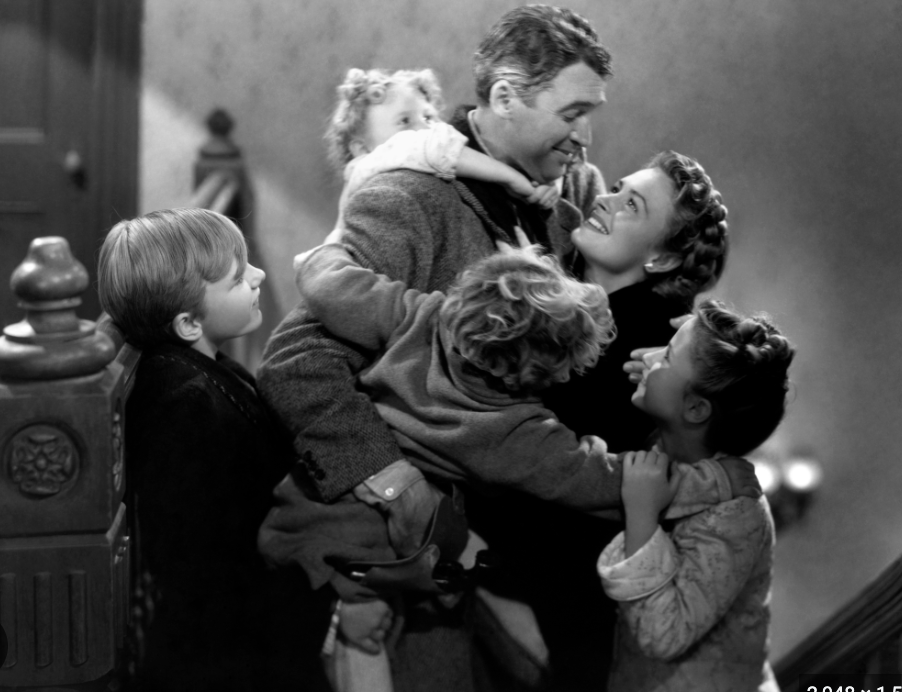
It’s a Wonderful Life. You know the story: George Bailey, a young boy, then a man with an adventuresome spirit, time and again sets aside his dreams to care for the people in his community. And when it all starts to unravel (absentminded Uncle Billy, mislaid money, opportunistic Old Man Potter), he learns that his years of sacrifice and generosity have amounted to something. He longed to see Tahiti and travel the world, and he felt the loss of that keenly at times. In the meantime, he built the very life he’d wanted to escape, and discovered it contained riches he hadn’t anticipated.

I especially want to understand that part of the movie, the part where George Bailey sets aside his dreams, over and over. What did the director, Frank Capra, mean for us to make of this? In a more do-your-dreams, you-can-have-it-all, American-type movie, George would have made it to Tahiti in the end. The reward for his kindness and selflessness would have been everything that happens in the movie, plus somehow he’d wind up in Tahiti.

But that’s not what happens.

Instead, we’re given to believe that he can live with his lost dreams as he learns to cherish what’s in front of him.

As teenagers, didn’t we all believe that to become an adult meant giving up one’s dreams? Most of us knew or heard about the things our parents had longed for and given up on. Flavored with a little contempt, didn’t our adolescent selves wonder how grownups could so easily give up on themselves? And didn’t we believe that we weren’t going to give up on our passions the way our parents had? We’d stay true to ourselves. 

Rather than hearing about our parents’ lost dreams, perhaps it would have been helpful to hear how they made peace with that loss. It would be like George Bailey saying to his kids, “I thought to live a good life I needed to travel, but it turned out by doing what I was good at, I built a rich life. I thought I was living a life that amounted to less than what I’d dreamt of, but it turns out it was more.”

What would George Bailey need to do before he could think of his lost dreams this way?

This question is not academic to me. Every holiday vacation, or on unexpected days off, my plan is to write, to make good on a dream I first had when I was 8 years old. Most times, I manage barely a toe-dip in that lake, and certainly nothing like the full immersion I long for. Nearly every time, a tension is created between the writing plans I make and what I’m able to actualize.

This vacation, I find myself wondering if it’s time to give up on this writing dream? It’s unpleasant and painful, the tension between longing and reality. Maybe that’s what all the adults were doing when they “gave up.” Maybe they needed to drop their dream because it seemed the only way to resolve that tension: Maybe I won’t feel so bad if I stop wanting what I want. 

But even while I feel discouraged, I also wonder if there’s a way to resolve the tension without dropping the dream?

I’m a student of Buddhism, and a foundational Buddhist concept speaks to the tension I’m describing by suggesting that we cultivate a stance where we neither cling to our dreams nor push them away. 

Doing this is hard.

Of course I’m thinking of giving up. Because it’s one thing to know the stance I need to cultivate and it’s another to actually mange to do it. How do you want something, and yet not want it so much that it causes distress, that it makes you wish for a life other than the one you lead?

This kind of suffering – called dukkha in the original language of the Buddha – is like any other suffering.  Dukkha describes how life is like a wagon wheel that’s out of true, and so it wobbles, one moment achieving balance, the next falling out of balance, and so on and so on. If it feels like just when things are going our way something  happens to mess it up – well, that’s just life being life. It doesn’t mean something’s wrong, though we will suffer doubly if we think it should be otherwise.

Maybe George Bailey was secretly a Zen master. At every moment in the film when he wants life to be other than it is, he remembers that life is a wobbly wagon wheel, so if it wobbles – if he thinks he’ll finally be able to leave Bedford Falls and travel around the world – he understands it’s life being itself when that’s suddenly snatched away by his father’s death, by his brother’s out-of-state job opportunity, by love.

If I were such a Zen master, I’d remember that if it didn’t work out for me to write quite as much as I’d hoped, or if I sat down to write but felt everything I wrote was crap – well, that wagon wheel is wobbling. It doesn’t mean it’s time to let go of my dream. It means our dreams are also part of life, and so they’re subject to being like life is.

It is a wonderful life, but wonderful doesn’t mean perfect or without trials. Wonderful might be possible only if we also notice what exactly is wonderful in our lives. When George Bailey gets his life back, as his friends and neighbors pile into his home to add their money to the overflowing basket, no part of his brain in that moment is wishing he had been able to travel more. He is simply present to the life he has.