
Archive

Memoir

“Don’t believe everything you think.”

This is one of my favorite bumper stickers, in part because it encapsulates what I’ve come to understand about our minds. Namely, that they are often untrustworthy. To wit, memory can change under the influence of others; we can believe we’re being objective when in fact we’re behaving from a place of beliefs and opinions; and if there are things we think, or behavior we engage in, that our brain doesn’t want to acknowledge as part of us, it will conveniently “forget” those thoughts and behaviors in order to maintain its preferred self-perception.

For nearly a hundred years, schools of psychology have explored the idea that much of our motivations, beliefs, and fears lie outside our conscious mind. In fact, neuroscience has recently confirmed that most of us operate from a place of 95% unconsciousness. Or, as one of my favorite psychologists, Polly Young-Eisendrath, puts it, “A little island of consciousness tries to justify what we do after we’ve done it.”

For example, if I like to think of myself as a nice person, but then I cut someone off in traffic, my mind will find all sorts of explanations for why I did that, but none of those explanations are likely to include the idea that sometimes I’m not nice. Our brain likes to believe what it believes, even in the face of evidence to the contrary.

At the dinner table the other day, my kids and husband were talking about the challenges of speaking directly to someone you’re in conflict with. Unbidden, a memory surfaced. One I haven’t thought about in 30 years.

***

Early on in my relationship with Mark, his grandmother died. His mom asked Mark and his two siblings to come help her and their grandfather to pack up the house in preparation for selling it. Mark and I lived in Texas at the time, so in the spring of 1989, we made the 33-hour drive to Albany, Oregon to help out. I’d only met Mark’s family a couple times; I still felt insecure around them and eager to please. I looked forward to helping clean and sort and pack boxes – things I was quite good at, and things that would enable me to lean on a shared activity while being around people I didn’t know very well.

Mark’s grandfather lived on a few, thickly-forested acres in north Albany in an old farmhouse. It was a beautiful patch of land, if a bit dark, even at high noon. A stack of broken-down packing boxes leaned against the side of the front porch when we pulled up. Inside were Mark’s grandfather, mother, older sister, Jennifer, and younger brother, Floyd. No actual packing had started. People walked around aimlessly, seeming uncertain where to start. I found their disorganization and lack of efficiency wearing.

“Where should we begin?” Jennifer asked, standing in the middle of the living room and looking about. She grabbed a stack of photo albums. “What about these?” She opened one. “Oh, wow. Mark, remember this?” She sat on the couch and patted the cushion next to her.

Mark sat and leaned toward the open pages and laughed at what he saw. “We’ve got to get Floyd in on this! Hey, Floyd!” He hollered for their brother. Floyd appeared in the doorway. “You’ve got to check this out, man.” Floyd sat on Jennifer’s other side and peered at the book. At intervals, Jennifer slowly turned a page and it would start again: “Do you remember that? Can you believe we were ever so little?”

I stood near them for 10, 20, 30 minutes as they strolled – inched – down memory lane with each other. Eventually their mother called from another room, “Is there any more packing tape?” Her three offspring lifted their heads, initially disoriented to be torn from their reminiscences.

Jennifer said, “I ran out of it, too, Mom.”

“I’ll go get more!” I volunteered. “Maybe the corner store has some?” Turning onto their grandfather’s road from Highway 20, there’d been a small convenience store west of the intersection.

Mark frowned. “Do you think they’ll have any?” he asked me.

“If not I’ll find somewhere else.”

“Maybe the office store across the river?” Jennifer suggested.

I grabbed my purse. “Sure. If the convenience store doesn’t have it.”

Mark began to look more energized with the sort of energy that might motivate him to accompany me, or might decide that my errand wasn’t actually a good idea after all. “‘Bye!” I said, and was out the door and into my car before anyone could think to stop me.

I was seething. I drove too fast down the country lane muttering, “Rude. Thoughtless. Uncaring. Exclusive.”

As I approached where the road intersected Highway 20, the tree cover gave way to a sparkling, blue-sky day. The corner store was to my right. Straight ahead was a green highway sign. Above an arrow pointing west it read: “Corvallis 10 miles.”  That’s what I needed to do: I needed to go to Corvallis. Screw packing tape; screw Mark; screw his rude family.

I turned the car toward Corvallis in a burst of gravel, feeling at once free and triumphant. Ha! They’d tried to make me feel small and unwelcome. Well, I’d show them, I’d step right out of the cone of shame they’d constructed for me and be my own club of one.

On a sunny, late spring day, the drive between Albany and Corvallis is one of the finest Oregon has to offer. The highway is lined on the river side with incense cedar and grand fir trees. To the right, farms and fields show the tender green of early growth and the occasional Oregon white oak to complete the pastoral scene. My spirits lifted to the point of giddiness. Somewhere along the way, I decided I couldn’t possibly go to Corvallis without getting lunch at Nearly Normal’s. Even better! I’d escaped the crushing experience of being ignored and now, as if that weren’t enough, I was going to get to eat my favorite barbequed tempeh burger. Life was good.

No one had a cell phone in 1989. I briefly considered finding a pay phone before remembering that I didn’t know Mark’s grandfather’s phone number or last name. So, off the hook.

As expected, my barbequed tempeh burger was delicious. As I finished it and wiped my greasy fingers, I felt perhaps I’d been gone long enough. I paid my bill and walked to the packaging and mail store down the block for packing tape.

Mark was on the porch sorting the flattened boxes when I drove up. He straightened and waited for me to turn off the engine and get out of the car. After driving in the sunshine, the yard felt cold and oppressive.

“Hi!” I said cheerfully. I held up the packing tape. “Got it!”

His expression was quizzical, and something else. Maybe annoyed. “Where were you?”

I shrugged. “You wouldn’t believe how hard it was to find packing tape.”

***

My family shrieked over this story. “Mom,” my daughter said. “Passive-aggressive much?”

“You think that was passive-aggressive?” I asked innocently. Telling the story, I felt effervescent, free. How had it slept in my Unconscious all this time, only to emerge whole at this precise moment?

Polly Young-Eisendrath might suggest that at the time this incident was happening, the story I told myself about it was one I liked: I’d been snubbed and took back my power. But not long after it happened, some part of my psyche knew the narrative was more complicated and less flattering than I’d first devised. But I wasn’t quite ready for this truer story, which featured me as not a hero, but as a scalawag. And so my mind did what minds do so well. It swept that story under the rug of my Unconscious.

Why did it emerge when it did? Things often skulk around in our Unconscious because our mind can’t tolerate anything that contradicts our self-perception. It can’t tolerate it because we experience this contradiction as shame: “It’s bad to be passive-aggressive. So if I’m featured in a story where I’m being passive-aggressive, I myself am, therefore, bad.” Most of us do anything we can to avoid feeling shame.

But something wonderful has happened with age. That story popped into my mind recently not just because it was relevant to our dinnertime conversation, but also because I can now accept that sometimes I’m passive-aggressive. And I can acknowledge the truth of this inside of a compassionate and full view of everything that I am. This updated, richer notion of what it means to be a human being enables me, instead of shying away from my flaws, to say instead, “Of course I’m passive-aggressive sometimes, I’m a human being. I’ll do my best to improve in this area, but there’s no need for me to rake myself over the coals for being imperfect; that just goes with the territory.”
One of the delights of writing these memories is that my parents get to read them, if they so choose. They did so choose with my last post, and they filled in a couple blanks I thought might interest one or two of you.

My mom was last seen driving away with my grandfather to pick up the backpackers. It was a hair-raising drive with lightning crashing down, first on one side of the road, then the other, practically the whole way there. They drove a road thick with dark, looming Douglas-fir on either side, certain that lightning would bring one crashing down upon them. That was their moment-by-moment terror.

Meanwhile, while much drama and anxiety were playing out on their behalf, the backpackers – having climbed a mountain, and then pushed themselves coming off the mountain in order to be at the agreed-upon pick-up site on time – slept warm and toasty in their tent. They were awakened only when the headlights from my grandfather’s station wagon arced into the parking lot at the trailhead.

Everyone safe and sound.

The family stood alongside their car, an orange and white VW van circa 1974. It was dusk in a land drier and dustier than they were used to. Where they stood, the sky maintained a late-afternoon quality, but further south, the sky boiled a blue-black darker than night. Branching, jagged lines of lightning cracked down from the clouds, their white-hot color contrasting with the darker sky.

The family was heading back east after a summer road trip that started in Massachusetts and extended as far west as Oregon. The vacation had worked wonders on the father. After so many drifting summer days strung together, he’d found more patience and tenderness than he usually felt for his family. Which may have been why, when his children asked him to photograph the lightning, he refrained from citing the speed of light, and human reflexes, and shutter speeds as a way to decline, and instead, for his four children, he promised four attempts to capture lightning with his camera. 

The children debated the merits of taking a photo after the lightning was sighted versus anticipating a flash in hopes that the camera would take a picture at just the right moment. 

As promised, the father took four photos. Months later, all the photographs from their summer journey were developed. These four photos mystified them at first. Absent any lightning on the film, they couldn’t remember why anyone would want to photograph this landscape. Then someone remembered. Remembering transformed the photos, changing them from puzzling if perfectly nice landscapes to concrete evidence of love.

***

The above was hardly my family’s first encounter with lightning. Earlier that same cross-country summer trip, while staying with my grandparents in Madras, Oregon, my dad and brother peeled off to make a two-day climb up Mt. Jefferson.They’d been dropped off at the crack of dawn two days previously, and as my mom and grandfather prepared to go collect them again, we looked uneasily at the sky. Weather was moving in, and we all thought anxiously of the backpackers coming off the mountain during a storm.

“Let’s leave now,” my grandfather said, an hour earlier than planned. The wind whipped the birch tree beside the driveway into a crazy dance as they headed out. 

The black afternoon light encroached for a long time; we didn’t think it was possible for it to get any darker. When the storm hit, it was anything but gradual. One minute, the high desert air held its usual parching heat; in the next, sheets of rain and explosions of thunder swept in.

You could say we were used to storms like this. They were not uncommon in Massachusetts where we’d been living. In fact, two years earlier, almost to the day, we lived in a 200-year-old farmhouse at the top of a rise. It sported seven lightning rods throughout the house. In that two-years-ago summer day, the usual heat and humidity were briefly broken by a storm at dinnertime. My mother thought we should turn off the dishwasher. I headed to the kitchen and stopped it just in time for the crack! that meant the house had been hit. Contained electricity snaked down the kitchen lightning rod, visible to me as it blazed toward the ground. But it’s nearly impossible to get used to thunder and lightning storms. They’re too erratic, too loud, too potentially deadly. 

Now, we sat huddled in my grandmother’s family room, me, my two younger sisters, my grandma, her youngest sister, Alice, and Grandpa Joe, their mother’s third husband.

If you were trapped in a storm, and both of your parents, and your older brother and grandfather were out in that storm, the best person in the world to be trapped with was our grandmother. She had survived countless storms by then – most of them of the non-weather sort. She had skills for just such moments.

“Let’s play rummy,” she said. My sisters were 11 and 8. Her house sat on a slope toward the top of a hill. The storm brought significantly cooler air than we’d felt during the day and we unlatched the windows, opening them a hair to feel the new coolness and to smell the scent particular to desert dust and sage pummeled by rain.

I was a veteran of the rained-out camping trip by this time and knew such a thing to be unpleasant but not necessarily dangerous. But this was next-level rain.  I envisioned my dad and brother descending from the mountain on trails turned to rivers, beneath trees that, in the absence of lightning rods, were the only things tall enough to guide the lightning to the ground.

My sisters and I had been taught to count the seconds between the lightning and thunder. It was meant to comfort us, I think, the assumption being that most storms would be far enough away to reach five, or four, or even three seconds, and thus we’d be reassured the storm was far enough away to offer us no danger.

“-three-one-thousand, four-one-thousand-” CRACK!

“Still a whole mile away,” I said.

Gram dealt the cards. Rummy was her favorite and we’d been practicing in hopes of offering her a little competition. Grandpa Joe didn’t join us. I was used to taciturn men in my extended family, men who couldn’t seem to be bothered to speak with women, and certainly not with children. How strange, to have become acclimated to a male body being in the room without it being a part of the goings-on, a body that expected to be offered food and drink without having to participate in any way.

“-two-one-thousand, three-one-thou-” CRACK!

I discarded a ten of clubs at the end of my turn. Grandma’s eyes twinkled, and she scooped up the entire discard pile, 12 cards in all. “Ha ha!” she laughed with glee.

“That might be your undoing,” Alice said with a wink to us kids. She could say such things and still win prizes for being the most sweet-natured woman of all time. 

My grandma’s stepfather, Louis – Alice’s father and their mother’s second husband – believed children were best disciplined through beating; he also believed daughters to be an extension of one’s wife. When you’ve been raised in such crushing harshness, you can go one of two ways in adulthood. You can allow it to leak into your child-rearing philosophy, or you can treat children like the tender shoots they are, like the tender shoot you were. 

To the extent that my grandmother survived Louis, she did so through the balm of humor, the unstoppable ability to laugh, to find the absurd, the one nugget of levity that might transform an experience, lighten it up. What started as a survival skill blossomed into a single-minded way of being. Stories abound in our family about her contagious laugh, a sound that could lift a tense atmosphere and invite others to laugh together, even when we weren’t sure what had originally been so funny.

“Do you think they’ve gotten to the mountain yet?” I asked.

Gram looked at the wall clock. Only 7:00. Full-on dark due to the storm. “They’re maybe halfway there by now.”

The family room had a couch, a couple recliners, and a small table with chairs. It lacked decoration unless the clock counted as such. The overhead light cast an interrogation-room glare.

“I imagine the storm will slow them down a little,” Alice said. “You’ll be in bed before they’re home.”

Flash! BOOM! The storm was on top of us.

My youngest sister hunched over and put her hands over her ears. We all remained fixed in place, as if by freezing we might escape the notice of the storm. The rain roared against the room, and the wind whistled through window screens, still cool but no longer a relief. We couldn’t hear each other to speak. The overhead light flickered.

Within clouds, when some of the precipitation moves rapidly upward, and other precipitation falls, their collision can create the fiery discharge we call lightning. The resulting current of electricity instantly heats the surrounding air. The air in turn expands, and then as suddenly collapses, creating shock waves along the entire bolt path: thunder. 

How long does a storm-on-the-move stay in one place? The answer is both too long, and, in the scheme of things, not long at all.

Flash! One-one-thousand, two-one-thousand, three-one-thou- Crack! It was moving away. Maybe staying motionless had helped: Nothing to see here.

The wind and rain began to ease. We’d be able to talk soon, but now I imagined the storm moving inexorably toward my parents and brother, traveling like some force released from the underworld, intent on destruction.

“Who needs a snack?” Gram asked.

“I brought some Ritz crackers and Cheez Whiz,” Alice announced.

We were hooked. Cheez Whiz was a thing of legend, something we’d never tried. Alice brought out her cheerful turquoise beach bag and pulled out the box and can.

Apparently Cheez Whiz was novel for Gram as well. She stared at the directions on the can. “How does this work?” she asked. 

Alice pulled a sleeve of crackers from the box. “Let’s see,” she said. She offered us each a cracker, tilting the sleeve toward us as if she planned to knight us with it. We each took one, though I could have eaten dozens given my post-terror appetite.

The Cheez Whiz was aptly named.  It did indeed whiz out of its container, wiggling onto the cracker, falling all over itself, piling into a squiggly mound before Alice let her finger off the button. “Be careful. It comes out fast.”

She passed it around. My 8-year-old sister cackled with delight as the Cheez Whiz overflowed her cracker and onto her fingers. She licked it off, her eyes shining. “It wiggles like worms.”

“Maybe it is worms,” Alice said.

“Worms, worms, worms,” Gram chanted. “We’re eating crackers and worms. Mmm, delicious!”

The meter of those words – crackers and worms – was irresistible.

We howled.

“How do these worms compare to the ones you’ve had before?” Gram asked.

“Oh, these are the best worms I’ve ever had,” Alice insisted.

“Me, too,” my 11-year-old sister agreed. We erupted again with silliness, laughter discharging our anxiety and ushering in relief that the storm had moved on.

“Crackers and worms, crackers and worms.”

***

There’s a photo from that night, a Polaroid that has survived the intervening 45 years. My grandmother took the picture. None of us sit fully in a chair except Grandpa Joe. The rest of us – Alice, my sisters, me – we’re all perched on something, the arm of a chair, the back of the couch. Each one of us girls holds a Ritz cracker, one raised to toast the photographer. My 11-year-old sister’s eyes are squinted closed with laughter. The flash from the camera and the overhead light conspire to wash things out, but you can still tell we three sisters have had the Platonic ideal of a summer. We are tanned from hiking Pacific Northwest trails, swimming in Oregon streams, picking blackberries in the blazing August sun, and sitting on countless front lawns meeting cousins we didn’t even know we had.

We look like children who’ve benefited from tenderness, who’ve thrived from it.

When I was four years old, we moved to the edge of Lake Mälaren in Sweden, a 40-minute car ride west of Stockholm. This was 1965. We arrived at the beginning of one of the hardest winters in popular memory. Though technically it was still autumn when we got there, snow already covered the ground and Lake Mälaren had begun its wintertime freeze. 

For months, the lake simply completed the view for me when I gazed out the picture window. The window was double-paned, and some magical soul had stuffed twigs and lichen between the windows at the base. They’d added small figurines – a deer, a fox – to finalize the miniature woodland scene. From where I stood at the window gazing past this charming scene, our yard stretched toward the lake, a gravel pathway leading to a small landing dock of silvery gray wood. During that winter, the lake remained covered in snow and froze so hard that cars could drive on it. It was rumored that Harald Wiberg – who’d illustrated the famous Tomten books by Astrid Lingren – lived on the island across the way.

After the thaw, we saw sailboats on the lake, their sails small and bright as freshly-washed handkerchiefs in the distance. One spring day, my brother, sister, and I had a harrowing experience with two swans. They were tired of being lured by the older neighbor boys with the promise of food only to be pelted with stones when they got close to shore. My siblings and I ran out of dried bread to feed them, and when they rose out of the water, wings spread, necks outstretched, and mouths hissing, we minced a painful, terrorized retreat up the gravel path in bare feet, screaming for our mother. On a bright sunny day in May, we raised a May pole and had a party in our yard next to the lake. We moved to Stockholm the following year to an enormous apartment complex, but it’s this red house by the lake that shaped my loving memories of Sweden.

This move to Sweden was only one of many moves in my childhood. My own children have not lived by a lake; they never moved from the house they were born in until college beckoned. They have not been in a position to be chased by aggressive swans. They have not experienced a winter so harsh that after 10 minutes in it they begged to be allowed back inside. They have not had to trudge to the local grocers in single file so their mother’s footsteps in the snow would keep them from sinking to their waists in the drifts.

As parents, we try to correct for those things we experienced as hardship. Our parents did this before us. It’s a parenting creed, to try and provide the conditions that will mean our children’s lives will be less hard than ours, that they’ll have fewer obstacles. But all we really know to avoid are the things we found challenging; we don’t know exactly what hardships our kids might benefit from, nor do we know which one might simply be an experience devoid of fulfillment, only to be endured and gotten through.

That first winter on the lake, a neighboring family, the Roths, took a shine to me. One day, they planned to ski beside and on the lake with another couple and with their nine-year-old, Anne-Katrin. I could use her old skis, they thought, and it would be nice for her to have a companion (this was before we all learned that Anne-Katrin wanted nothing less than to have me as a companion). 

I’m curious how all of this was arranged. Did my parents want to say no but couldn’t find a polite way to do so? Did they think what a relief it would be to have one fewer kid to track for an afternoon? Did they think it’d be fun? 

Regardless, I found my four-and-a-half-year-old self at the lake one day with Anne-Katrin’s stubby orange skis strapped to my feet. I was dressed for the cold; the day was gray with low clouds reminiscent of the Pacific Northwest. I had never been on a pair of skis in my life. We set out with me bringing up the rear so as not to slow anyone down. We skied on a path that skirted the lake when we weren’t on the lake itself, and the wintertime deciduous trees had cleared out their leaves to improve the view. But it took almost no time before my view contracted to include little more than the bright-colored tips of my skis following the person ahead of me.

Did I mention that the heel didn’t lift off the ski? Traditionally, cross country skis are designed such that the leg and foot of the skier act a bit as if one is running. To execute the most efficient glide, the heel on the back leg lifts followed by a forward stride. Without that, one is destined to merely shuffle along the snowy track. During this ski trip, a glide only happened on the occasional decline – or if I positioned my poles just right I could give myself a shove toward a brief momentum. 

This afternoon marks my first experience of pushing past what I understood the limits of my endurance to be. Telling this story later in life, I told people we skied around the lake but that would have been impossible: its circumference is over 200 miles. More accurately I might have said it felt like I’d skied around the lake. By the end of the excursion, my senses had narrowed to a pinpoint: the scratchy dampness of condensation on the scarf that covered my panting mouth; the scrape and shush of skis over snow alternately rough and smooth; achey shoulders from overusing my poles in an effort to save my trembling legs; and the broad orange tips of those skis always going on before.

I didn’t really know the Roths. I didn’t have the sort of easy interaction with them that would have enabled me to say, “Excuse me, but I’m hungry / tired / finished.”  At the close of our afternoon, the Roths praised my endurance, my stoicism and athleticism. What a trooper I was!

Was this a useful childhood experience? We know it’s good for us to not always stay in our comfort zone. That’s how we find out what we’re capable of. But what about when we’re too far outside of our comfort zone? Do those moments offer us anything? Did this experience truly teach me that I was stronger than I thought, more capable? Or did that lesson come from other more satisfying experiences later in life where I felt a little more choice, more agency? I don’t know the answer to that. It’s hard not to try and shape this tale as one where I overcame adversity, but all I really felt at the end of that experience was miserable and tired. 

What is my children’s equivalent to this? In what ways would they say they’ve pushed themselves and found they could do more than they suspected they were capable of?  I keep encountering articles on Facebook and elsewhere that are intent on sounding the alarm that our kids aren’t as tough as my generation was and that this presages some tragic outcome. Maybe that’s true; I don’t know. The very concern implies that we believe it’s possible as parents to have some control over the sorts of hardships our children have but that hasn’t been my experience. Oh, I may have tried to not put them in a position as four-year-olds where they were required to ski around a lake with people they didn’t know well enough to complain to; I may have succeeded somewhat in protecting them from that.

But growing up in this human form is inherently full of hardship. I don’t actually know everything my kids have endured, but I’d be crazy to assume therefore that they’ve not had to endure much. For starters, they’ve had to tolerate the adults of today who think their modern hardships don’t even qualify as such. It’s our current equivalent of having to hear how your grandfather walked five miles to school every day in the snow, uphill both ways. Some of today’s youth haven’t suffered the specific hardships experienced by their parents, but do we really think what they have suffered somehow counts for less?

I’ve not been back to Sweden. I hope to return someday. It will have changed. When I think of Lake Mälaren, I think of how, when we stood looking out from our house, it filled my vision. More than that afternoon with the Roths, I remember a cerulean sky with a smattering of white clouds, both features mirrored in the blue water of the lake, the sailing boats’ billowy white sails looking like reflected clouds.

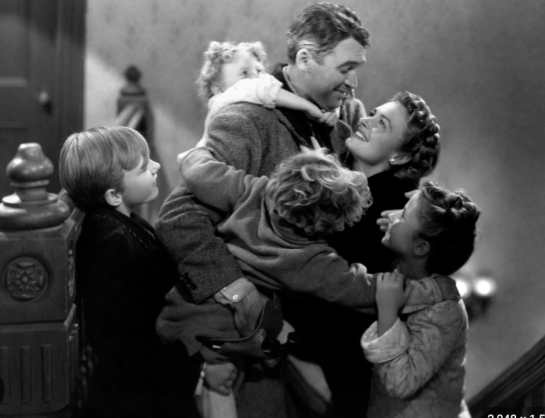
Screen Shot 2022-12-25 at 10.59.01 AM

It’s a Wonderful Life. You know the story: George Bailey, a young boy, then a man with an adventuresome spirit, time and again sets aside his dreams to care for the people in his community. And when it all starts to unravel (absentminded Uncle Billy, mislaid money, opportunistic Old Man Potter), he learns that his years of sacrifice and generosity have amounted to something. He longed to see Tahiti and travel the world, and he felt the loss of that keenly at times. In the meantime, he built the very life he’d wanted to escape, and discovered it contained riches he hadn’t anticipated.

I especially want to understand that part of the movie, the part where George Bailey sets aside his dreams, over and over. What did the director, Frank Capra, mean for us to make of this? In a more do-your-dreams, you-can-have-it-all, American-type movie, George would have made it to Tahiti in the end. The reward for his kindness and selflessness would have been everything that happens in the movie, plus somehow he’d wind up in Tahiti.

But that’s not what happens.

Instead, we’re given to believe that he can live with his lost dreams as he learns to cherish what’s in front of him.

As teenagers, didn’t we all believe that to become an adult meant giving up one’s dreams? Most of us knew or heard about the things our parents had longed for and given up on. Flavored with a little contempt, didn’t our adolescent selves wonder how grownups could so easily give up on themselves? And didn’t we believe that we weren’t going to give up on our passions the way our parents had? We’d stay true to ourselves. 

Rather than hearing about our parents’ lost dreams, perhaps it would have been helpful to hear how they made peace with that loss. It would be like George Bailey saying to his kids, “I thought to live a good life I needed to travel, but it turned out by doing what I was good at, I built a rich life. I thought I was living a life that amounted to less than what I’d dreamt of, but it turns out it was more.”

What would George Bailey need to do before he could think of his lost dreams this way?

This question is not academic to me. Every holiday vacation, or on unexpected days off, my plan is to write, to make good on a dream I first had when I was 8 years old. Most times, I manage barely a toe-dip in that lake, and certainly nothing like the full immersion I long for. Nearly every time, a tension is created between the writing plans I make and what I’m able to actualize.

This vacation, I find myself wondering if it’s time to give up on this writing dream? It’s unpleasant and painful, the tension between longing and reality. Maybe that’s what all the adults were doing when they “gave up.” Maybe they needed to drop their dream because it seemed the only way to resolve that tension: Maybe I won’t feel so bad if I stop wanting what I want. 

But even while I feel discouraged, I also wonder if there’s a way to resolve the tension without dropping the dream?

I’m a student of Buddhism, and a foundational Buddhist concept speaks to the tension I’m describing by suggesting that we cultivate a stance where we neither cling to our dreams nor push them away. 

Doing this is hard.

Of course I’m thinking of giving up. Because it’s one thing to know the stance I need to cultivate and it’s another to actually mange to do it. How do you want something, and yet not want it so much that it causes distress, that it makes you wish for a life other than the one you lead?

This kind of suffering – called dukkha in the original language of the Buddha – is like any other suffering.  Dukkha describes how life is like a wagon wheel that’s out of true, and so it wobbles, one moment achieving balance, the next falling out of balance, and so on and so on. If it feels like just when things are going our way something  happens to mess it up – well, that’s just life being life. It doesn’t mean something’s wrong, though we will suffer doubly if we think it should be otherwise.

Maybe George Bailey was secretly a Zen master. At every moment in the film when he wants life to be other than it is, he remembers that life is a wobbly wagon wheel, so if it wobbles – if he thinks he’ll finally be able to leave Bedford Falls and travel around the world – he understands it’s life being itself when that’s suddenly snatched away by his father’s death, by his brother’s out-of-state job opportunity, by love.

If I were such a Zen master, I’d remember that if it didn’t work out for me to write quite as much as I’d hoped, or if I sat down to write but felt everything I wrote was crap – well, that wagon wheel is wobbling. It doesn’t mean it’s time to let go of my dream. It means our dreams are also part of life, and so they’re subject to being like life is.

It is a wonderful life, but wonderful doesn’t mean perfect or without trials. Wonderful might be possible only if we also notice what exactly is wonderful in our lives. When George Bailey gets his life back, as his friends and neighbors pile into his home to add their money to the overflowing basket, no part of his brain in that moment is wishing he had been able to travel more. He is simply present to the life he has.